How Much Does It Cost to Install a Home EV Charger in the Netherlands? (2026)

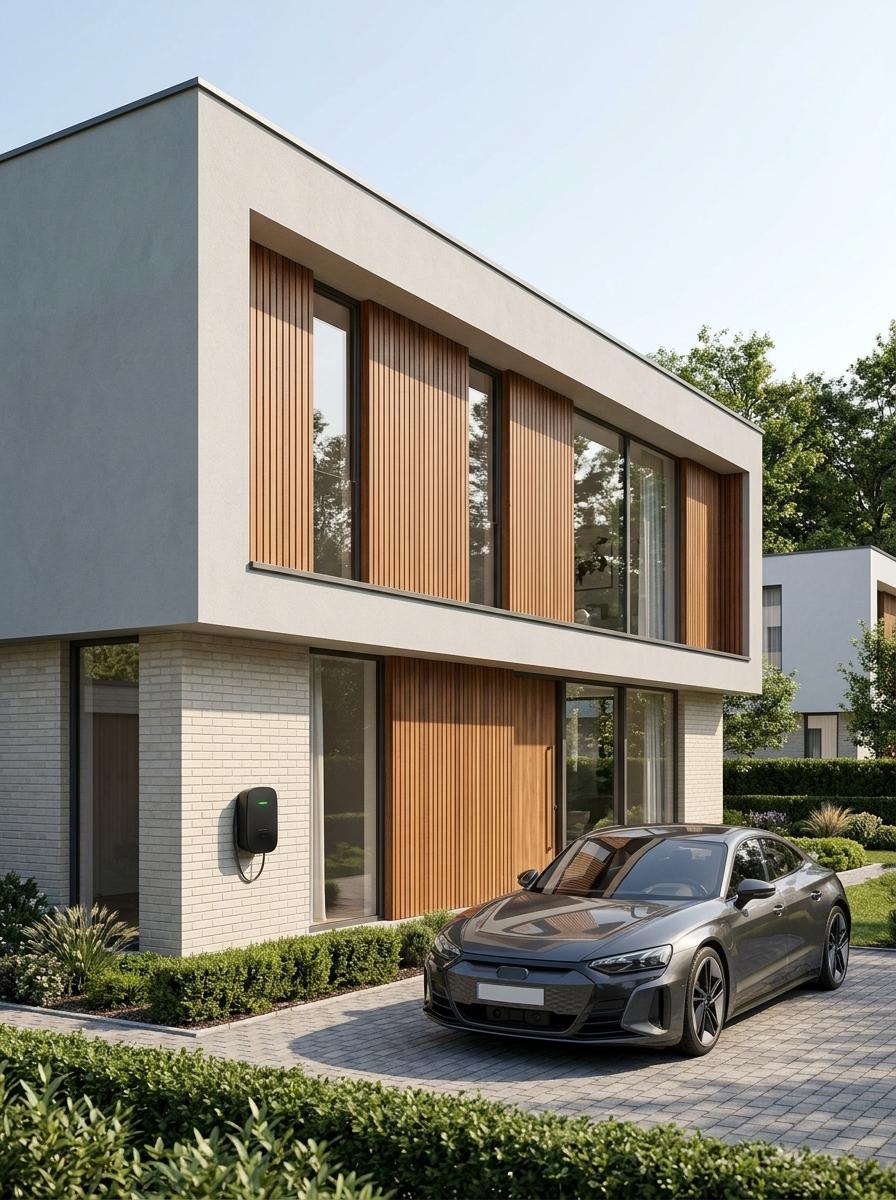
Direct answer: Home EV charger installation in the Netherlands costs around €1,000 to €2,000 in 2026, including the charger. Simple jobs start at about €850, and complex jobs can reach €3,500 or more (Trustoo quote data, 2026). At Vonk je Laadpaal, a complete package costs €1,250 to €1,950. It includes an A-brand charger, dynamic load balancing and installation with up to 5 metres of cable. A home that needs a 3-phase upgrade pays €1,500 to €3,500, because the grid operator and often the fuse board must change first. If you already own a charger, installation alone starts at €295, compared with around €375 to €700 at other Dutch installers.
Most of the price difference between homes comes from the meter cupboard (meterkast), not from the charger. A 1×25A connection gives the whole house 5.7 kW, while a 3×25A connection gives 17.3 kW (RVO, October 2026). The charger must share that power with your oven, washing machine and heat pump. Below you can see what each part of the job costs and which Dutch rules affect the price. You can also see how quickly a home charger earns its cost back.
All prices include 21% VAT. Vonk je Laadpaal prices come from its price list on 15 November 2026.
What does a home EV charger cost in total?
A home EV charger with installation costs around €1,000 to €2,000 in the Netherlands. A Vonk je Laadpaal installation package costs €1,250 to €1,950. The table shows what is included and which extras can come on top.
| Part of the job | Cost (incl. VAT) |
|---|---|
| Complete package: A-brand charger, dynamic load balancing, installation up to 5 m | €1,250–€1,950 |
| Installation only, if you already own a charger | from €295 |
| Charger only, for example Ratio Solar MID Socket / Easee Charge Max / Zaptec Go 2 | €795 / €850 / €850 |
| New fuse board with 6 to 12 groups | €786–€1,010 |
| Fuse board made ready for 3-phase | +€181 |
| Grid operator fee for 1-phase to 3-phase (billed by the grid operator) | €258.95–€368.77 |
| Cable route longer than 5 m, or a freestanding post | Quoted per home |
The complete package covers everything between the meter cupboard and the charger for routes up to 5 metres. That includes the underground power cable and a data cable, the trench, neatly re-laid brick paving and drilling through walls. It also includes routing through the crawl space and a group of its own with a residual-current device. Load balancing on your smart meter is part of it too. The electrician then sets up and tests the charger and explains how it works.
Other Dutch installers quote similar totals. Quote data from OfferteAdviseur puts the average at about €1,500, with most quotes between €1,250 and €2,200 (Voltoo, 2026).
What installation alone costs at other Dutch installers
Installing a home EV charger you already own costs around €375 to €700 in the Netherlands (Trustoo, 2026). The price rises to €700 to €1,200 when the cable must go underground (Werkspot, 2026).
| Installer or source | Installation only | What the price covers |
|---|---|---|
| Vonk je Laadpaal | from €295 | Installing a charger you already own |
| Wallbox Discounter | €399 | Call-out, labour and digging up to 5 m |
| Zoofy | €450–€500 | Labour and VAT for a standard job |
| Trustoo quote average | €375–€700 | Standard job; digging and fuse-board work cost extra |
| Werkspot average | €700–€1,200 | Installation including digging |
Installers that charge by the hour ask €50 to €75 per hour, or €75 to €125 for an urgent job. Many add a starting fee of €100 to €150 (Trustoo). On a typical quote, about 55% of the price goes to the charger and materials, 40% to labour and 5% to travel and admin.
Send clear photos of your meter cupboard and parking spot before the visit. Some installers charge a fee when they cannot finish the job because the information was wrong. Wallbox Discounter, for example, bills €189.94 for such a wasted visit.
How much does each type of home charger cost?
The type of charger decides how fast you charge and what your home needs. Most electric cars charge at 11 kW at most on a home charger, so a 22 kW charger rarely charges faster.
| Charger type | Power | Range added overnight (8 hours) | What your home needs | Typical price incl. installation |
|---|---|---|---|---|
| 1-phase, 16A | 3.7 kW | about 160 km | Any 1-phase connection | €850–€950 |
| 1-phase, 32A | 7.4 kW | about 320 km | 1×35A and load balancing | €850–€1,300 |
| 3-phase, 16A | 11 kW | about 480 km | 3×25A | €1,000–€1,700 |
| 3-phase, 32A | 22 kW | only if your car accepts 22 kW | 3×32A or more | €1,079–€1,900 |
Range per hour from Voltoo (2026): about 20, 40, 60 and 120 km. Installed prices from Trustoo quote data (2026).
A 1-phase charger is enough for most daily driving
A 3.7 kW charger adds about 160 km in one night, which covers most commutes. On a 1×35A connection, a 7.4 kW charger doubles that. It does need load balancing, because 8 kW is all the house gets. About 4 million Dutch homes have a 1×35A connection. The government study Kansen achter de meter (June 2026) found that a charger works on them, as long as it has load balancing. The same study advises against a charger on the roughly 1 million homes with 1×25A, even with load balancing, because the house would go over its limit too often.
A 3-phase charger suits long daily distances
An 11 kW charger adds about 60 km per hour, so it suits drivers who cover long distances every day. It needs a 3×25A connection. However, your grid bill does not rise when you move to 3×25A. Every connection up to 3×25A pays the same capacity tariff (ACM, 2026).
A 22 kW charger usually costs more than it gives
A 22 kW charger only charges faster if your car's onboard charger accepts 22 kW, and most cars do not. It also needs at least 3×32A, which puts you above 3×25A. At Enexis, that raises the yearly capacity tariff from €305.36 to €1,526.80 excluding VAT (ACM, 2026). That is about €1,478 more every year including VAT, so 11 kW is the better choice for almost every home.
A MID meter matters for a lease car and for ERE income
A MID meter is a certified kWh meter inside the charger. Your employer and the tax office accept its readings, so you need one to claim charging costs for a company car. You also need it to earn ERE income, explained further down. The Ratio Solar MID Socket, Easee Charge Max and Zaptec Go 2 all have a MID meter.
Charging from a normal socket costs nothing extra, but it is slow
Most electric cars come with a 230-volt cable for a normal socket. It charges at 2.3 kW at most, because the cable limits the current to 10A (ANWB). In 8 hours that adds about 18 kWh, or about 100 km of range.
That is fine now and then, or for a plug-in hybrid with a small battery. A normal socket is not built for hours of full power every day, so the risk of overheating grows, and you should never use an extension cord. A socket also has no MID meter or load balancing, so you cannot earn ERE income or claim the kWh from your employer.
A bidirectional charger costs about twice as much or more
A bidirectional charger can also send power from your car back to your home (V2H) or to the grid (V2G). It costs about €3,000 to €6,000 with installation, roughly twice the price of a normal charger or more (Trustoo, Homedeal). The charger alone can cost up to €4,500 (Zonneplan).
Your car must support it too. Renault planned to roll out V2G for Dutch drivers in the first half of 2026, as the first brand with a complete system (AutoReview). Many other cars and chargers are not ready yet, so a normal 11 kW charger is the better buy for most homes today.
What changes the final installation price?
Every home is different, so the same package can need different extra work. These are the seven things that move the price most.
The distance from your meter cupboard to your parking spot
Every metre of cable costs money, and so does the work to hide it. The complete package covers up to 5 metres, including the trench and re-laying the paving. A longer route gets a price for your home. As a guide, the market rate is about €30 to €70 per extra metre (Voltoo). Routes longer than 25 metres often need a thicker cable to prevent power loss, which adds another €100 to €200.
The capacity of your grid connection
A 1-phase connection is often too small for a fast charger when the oven or heat pump is also on. You can check your connection by looking at the main switch in your meter cupboard. Two poles mean 1-phase and four poles mean 3-phase (Overstappen.nl). Load balancing lets a charger work on 1-phase, while an upgrade to 3-phase lets it charge at 11 kW.
Load balancing, if your quote leaves it out
Load balancing adds €100 to €300 when it is built into the charger. As a separate module it costs €50 to €150, plus a data cable if the meter cupboard is far from the charger (Trustoo). Chargers such as the Zaptec Go 2 and Easee Charge Max have it built in.
Check which type the quote names. Static load balancing caps the charger at a fixed power, for example 10A, even when the house uses little. Dynamic load balancing reads your smart meter through the P1 port and adjusts the power all the time. Dynamic is the better choice with a heat pump, an induction hob or a 1-phase connection.
| Part | What it does | Cost (incl. VAT) |
|---|---|---|
| P1 meter reader | Reads live use from your smart meter | €30–€120 |
| P1 splitter | Lets several devices read the P1 port | €25–€50 |
| CT clamp | Measures use around the main cables | €50–€75 |
| Data cable | Connects the smart meter to the charger | €75–€335 |
Source: Trustoo (2026).
A second EV or a shared charger
Two cars can share one connection. You can fit a second charger or one charger with two outlets, and load balancing splits the power between them. A 3-phase connection helps most here, because 1-phase leaves little power for two cars.
You can also share a charger with a neighbour. You split the cost of the charger and the installation, and each person pays for their own electricity. To bill each kWh correctly, you need a MID meter and a charger that logs each user, for example with a charge card (Trustoo).
The age and space of your fuse board
The charger always gets a group of its own with a residual-current device. If your fuse board has a free space, the package covers this. An older or full board needs replacing, which costs €786 for 6 groups up to €1,010 for 12 groups. Making the new board ready for 3-phase adds €181.
The safety switch the charger needs
Every charge point needs its own residual-current device under NEN 1010. That is either a 30 mA type A switch with 6 mA DC detection in the charger, or a 30 mA type B switch. Most new chargers have DC detection built in, so the cheaper type A switch is enough. A quote should always name the type, because the wrong switch does not protect you properly.
The way the charger is mounted
A wall mount next to the house is the cheapest option. But a freestanding post costs more because it needs a base in the ground and a longer cable, so Vonk je Laadpaal prices it per home. A charger outside also needs a weatherproof housing, so check its IP rating in the specifications. A fixed cable looks tidy and you can lock it. A socket lets you use your own cable, which helps if you change cars or share the charger.
Which Dutch fees and rules can add cost or time?
Four Dutch rules can change your plan: grid operator fees, waiting lists, VvE rules and municipal rules for cables. Most cost guides leave these out, but they often decide the final bill.
Grid operator fees for a 3-phase upgrade
Your grid operator, not your installer, upgrades your connection and bills you directly. Which operator you have depends on where you live, and all of Noord-Holland is in Liander's area.
| Grid operator | 1×25A or 1×35A to 3×25A (2026, incl. VAT) |
|---|---|
| Stedin | €258.95 |
| Enexis | €275.15 |
| Liander | €368.77 |
Source: tariff overview 2026, Gaslicht.com.
Waiting lists for a heavier connection
From 1 July 2026, households that ask for a new or heavier connection can go on a waiting list in busy grid areas (ACM). One household asked Liander for an upgrade from 1×35A to 3×25A in June 2025 and was still waiting for 2026. The ACM ruled that this wait was not unreasonable. In July 2026 the grid operators advised homeowners to see what fits on 1-phase first. If you need 3-phase, ask for it early and start charging on 1-phase with load balancing.
VvE permission for apartments
About 1.2 million Dutch homes are in a VvE, which is 17% of all homes. In most VvEs the general meeting decides on your charger. VvEs that use the 2017 model rules (Modelreglement 2017, article 28.3) let owners simply notify the board. A law that gives every owner this right was delayed in July 2026 and has no start date yet. If you rent, you need your landlord's permission before any work starts.
Permits and cables across the pavement
You do not need a permit for a charger on your own land. The exception is a listed building or a home in a protected town view. A cable across the pavement is different, because each town (gemeente) sets its own rules. Haarlem set rules for this in September 2025 under article 2:10 of its local bylaws. Heemstede lays special pavement tiles with a cable channel (kabelgoot). Where a town allows a cable, the ANWB names four usual conditions. The charger stands on your land and the cable crosses at most 10 metres. A mat covers the cable, and you put it away after charging.
Yearly costs after installation
A home charger costs little to run apart from the electricity itself. Most chargers work without a paid app, and some charge up to €5 a month. A yearly inspection costs about €50 to €100 and is advised but not required for a home. Check whether your home insurance covers the charger, because some insurers add €20 to €50 a year. Repairs are rare, but a fault check costs about €75 to €150 and a new charging cable €120 to €300 (Trustoo). The maker's warranty on the charger usually lasts 2 to 5 years.
Taking your charger with you when you move
The charger you bought is yours, so you can take it when you move. A certified installer must take it down and fit it again at the new home. This costs a few hundred euros for a simple job, and up to about €1,000 with digging or fuse-board work (ID.nl).
You can also leave the charger behind and add its value to the sale price. If you lease the charger, ask the lease company first, because you may not be allowed to move it.
Is there a subsidy for a home EV charger in 2026?
There is no national subsidy for a private home charger in 2026 (RVO). Some websites claim the ISDE subsidy pays up to €750 or €850 for a charger, but RVO does not list home chargers under ISDE. Three other schemes can still lower your costs.
| Who you are | Scheme | What you get |
|---|---|---|
| VvE | SVVE (RVO) | Subsidy for charging advice and basic wiring. €6.8 million of the €10 million budget was left on 30 September 2026. |
| Business | SPRILA (RVO) | €800 per 11 kW charge point for small firms, €400 for large firms. Apply between 20 January and 18 December 2026. |
| Employee with a company car | Employer reimbursement | Your employer can pay for the home charger tax-free |
| Self-employed or company | KIA (Belastingdienst) | Deduct 28% of the investment from your profit when your total business investments that year are between €2,901 and €70,602 |
| Private homeowner | Local schemes | Some towns run their own subsidy, so check your town's website |
Your employer can pay for a charger for a company car
Your employer can pay for a home charger tax-free if you charge a company car at home (Handboek Loonheffingen 2026, section 23.3.9). Your employer can also pay you back for the electricity, but only at your real cost per kWh, not a national average. That is why you need a MID meter for the kWh and your energy contract for the price. On 3 August 2026 the tax office ruled that ERE income is not salary. It does lower the kWh cost your employer may pay back, unless you agree to a separate price at market rate.
Entrepreneurs can deduct the charger from their profit
If you are self-employed and the charger is a business asset, the small-scale investment deduction (KIA) can apply. In 2026 you deduct 28% of the investment from your profit when your total investments that year fall between €2,901 and €70,602 (MKB Servicedesk). A charger alone usually costs less than €2,901, so it counts only together with other investments in the same year.
The MIA and Vamil schemes give up to 45% extra deduction, but only for products on the Milieulijst 2026 with the right code. You must report the investment to RVO within 3 months of ordering (Grant Thornton). Check the list or ask your accountant before you buy.
How much can you earn with ERE for charging at home?
Since 1 January 2026, you can earn money for every kWh you charge at home through the ERE scheme (emissiereductie-eenheden). Fuel companies must cut their CO₂ emissions, so they buy the credits your charging creates. In 2026 this pays about 7 to 10 cents per kWh (Radar), but the price moves with the market.
To take part, your charger needs a MID meter and you need a registered service provider (inboekdienstverlener). You cannot register the kWh yourself, and you can use only one provider per calendar year. The provider takes a share before it pays you.
| Yearly charging at home | ERE income at 7 cents | ERE income at 10 cents |
|---|---|---|
| 1,800 kWh (10,000 km) | €126 | €180 |
| 2,700 kWh (15,000 km) | €189 | €270 |
| 3,600 kWh (20,000 km) | €252 | €360 |
Based on 18 kWh per 100 km.
If you have solar panels, check one rule first. The NEa currently counts only the kWh you take from the grid, not your own solar power. It said in 2026 that it will update this explanation.
How much do you save by charging at home?
A driver who covers 15,000 km a year saves about €594 a year by charging at home instead of at public chargers. That driver uses about 2,700 kWh a year. At home this costs about €729 at €0.27 per kWh, while public charging costs about €1,323 at €0.49 per kWh. Fast charging at about €0.78 per kWh would cost about €2,100. The home price matches CBS data: in September 2026 the average Dutch household paid about €0.26 per kWh for supply and energy tax.
A full charge of a 60 kWh battery costs about €16 at home, €29 at a public charger and €47 at a fast charger. Per kilometre, charging at home costs about 5 cents. Driving on petrol costs about 14 cents per kilometre, based on 6 litres per 100 km and €2.28 per litre, the average at unmanned stations outside motorways in August 2026 (CBS). So fast charging costs about the same as petrol.
| Way of charging or fuelling | Full charge (60 kWh) | Cost per km | 15,000 km a year |
|---|---|---|---|
| Home (€0.27 per kWh) | €16.20 | €0.049 | €729 |
| Public charger (€0.49 per kWh) | €29.40 | €0.088 | €1,323 |
| Fast charger (€0.78 per kWh) | €46.80 | €0.140 | €2,106 |
| Petrol (€2.28 per litre) | not applicable | €0.137 | €2,052 |
Based on 18 kWh per 100 km for the EV and 6 litres per 100 km for a petrol car.
A €1,250 package earns itself back in about 2.1 years on these savings alone. With ERE income of €189 to €270 a year, that drops to about 1.5 years.
When a home charger is not worth it
A home charger pays back slowly if you drive little. At 5,000 km a year you charge about 900 kWh and save about €198 a year. With ERE that becomes about €260 to €290, so a €1,250 package takes 4 to 5 years to earn back. A charger is also not possible without a parking space on your own land. In that case, ask your town for a public charger in your street.
How does a professional install a home EV charger?
A home charger installation follows the same order every time. Vonk je Laadpaal finishes most installations in one visit of about 3 to 5 hours.
- Request and quote. You send photos of your meter cupboard and parking spot. You receive a quote within 24 hours, with the charger, the installation and any extra work on separate lines.
- Check and prepare. The electrician checks your connection, the free space in your fuse board and the cable route. If you need a 3-phase upgrade, you request it from your grid operator first. Clear the space around the meter cupboard and the parking spot, so work can start straight away.
- Cable and fuse board. The electrician lays the cable from the meter cupboard to the parking spot, through walls, the crawl space or a trench. In the fuse board, the charger gets a group of its own with a residual-current device.
- Mounting and load balancing. The electrician mounts the charger and connects load balancing to the P1 port of your smart meter. The data cable gives the charger a steady connection, even where Wi-Fi is weak.
- Testing and handover. The electrician tests the installation to NEN 1010 and shows you the charger and its app. You pay once the charger is working.
Most charger installations take place within one week of your approval. Your installation has a 5-year warranty, and the charger keeps the maker's warranty.
What problems come up during installation?
Most problems with a home charger come from too little power, a weak signal or a slow grid operator. Each one has a simple fix if you plan ahead.
Fuses trip when the charger and the oven are on
The main fuse trips when the charger and other appliances together ask for more than your connection gives. Dynamic load balancing prevents this by lowering the charging power when the house needs more. That is why every Vonk je Laadpaal package includes it.
The charger loses its internet connection
Smart charging and the app stop working when the charger loses its connection. A data cable from the house avoids this, and the complete package includes one. A charger with built-in 4G, such as the Easee Charge Max, is another option.
The 3-phase upgrade takes months
A grid upgrade can take months in busy grid areas since the waiting-list rule of 1 July 2026. Request it as soon as you order your car. Until it arrives, a charger with load balancing can charge on 1-phase.
The charger does not match the car
A 22 kW charger brings no gain if your car charges at 11 kW at most. Check your car's onboard charger before you buy, and choose 11 kW unless your car accepts more.
How can you save on a home EV charger?
These five steps lower the total cost without cutting corners on safety.
- Buy the charger and the installation together. A complete package includes load balancing and up to 5 metres of cable, so there are fewer extras.
- Choose 11 kW instead of 22 kW. You avoid a heavier connection and a much higher yearly grid bill.
- Plan before your car arrives. You can charge at home from day one and have time for a grid upgrade if you need one.
- Ask your employer to pay. With a company car, your employer can pay for the charger and the electricity tax-free.
- Charge on solar power and earn ERE. Net metering (salderingsregeling) ends on 1 January 2027, so solar power you use yourself becomes worth more. ERE adds 7 to 10 cents for every kWh you charge.
A dynamic energy contract only saves money if your charger charges in the cheap hours. In September 2026, the average dynamic supply price was higher than the average fixed price (CBS). So set your charger to charge at night or on sunny afternoons.
Why should a certified installer fit your charger?
A charger runs at high power for hours, so a mistake in the installation is a fire and safety risk. Dutch building rules (Bbl) require every charge point to meet NEN 1010. A charger fitted by someone without the right skills can also lose its warranty and its insurance cover.
When you compare installers, check these points:
- The installer is recognised by InstallQ and works to NEN 1010.
- The quote shows the charger, the installation and every extra on separate lines.
- The quote names the type of residual-current device.
- The installer tells you if you need a grid upgrade and what it costs.
- The warranty on the work is in writing.
Vonk je Laadpaal is recognised by InstallQ, holds VCA* certification and works to NEN 1010 and NEN 3140. It has installed more than 120 EV chargers so far.
Frequently asked questions about home EV charger costs
How much does a home EV charger cost in total in the Netherlands?
Home EV charger installation in the Netherlands costs around €1,000 to €2,000, including the charger. At Vonk je Laadpaal it costs €1,250 to €1,950. That includes an A-brand charger, load balancing and up to 5 metres of cable. A home that needs a 3-phase upgrade pays €1,500 to €3,500. If you already own a charger, installation starts at €295.
Can I install a home EV charger myself?
You should not install a home charger yourself. Every charge point must meet NEN 1010, and the installer must test the safety switch before use. If you do it yourself, you risk the charger warranty and your insurance cover.
Do I need a 3-phase connection for a home charger?
You do not need 3-phase for a home charger. A 1-phase home can charge at 3.7 kW, or at 7.4 kW on 1×35A with load balancing. You only need 3×25A for 11 kW charging.
How long does it take to install a home EV charger?
The installation takes about 3 to 5 hours in one visit. Vonk je Laadpaal usually installs within one week of your approval. A 3-phase upgrade comes first if you need one, and that can take weeks or longer.
Are there government subsidies for home EV chargers in the Netherlands?
There is no national subsidy for a private home charger in 2026. A VvE can apply for SVVE and a business for SPRILA. With a company car, your employer can pay for the charger tax-free, and ERE pays 7 to 10 cents per kWh you charge.
How much money do I save by charging at home instead of at public chargers?
At 15,000 km a year you save about €594 compared with public chargers. Home charging costs about €0.27 per kWh, while public charging costs about €0.49. ERE income adds €189 to €270 a year on top.
How much does it cost to install a charger I bought myself?
Installing a charger you bought yourself costs around €375 to €700 in the Netherlands, or €700 to €1,200 when the cable must go underground. At Vonk je Laadpaal, installing your own charger starts at €295.
Can I charge my EV from a normal socket?
Yes, but only at 2.3 kW, which adds about 100 km in 8 hours. It is fine now and then, but not for daily charging, and it does not count for ERE income.
How much does a bidirectional charger cost?
A bidirectional charger costs about €3,000 to €6,000 with installation. Your car must support V2H or V2G, and few cars do in 2026.
What does it cost to move a charger to a new home?
Taking a charger down and fitting it again costs a few hundred euros for a simple job, and up to about €1,000 with digging or fuse-board work.
Get a price for your home
Vonk je Laadpaal installs home EV chargers across Noord-Holland, from Haarlem and Velsen to Amsterdam, Alkmaar and the Zaanstreek. You get a quote within 24 hours, installation usually within one week, and a 5-year installation warranty. You pay once your charger works.
Request a free quote · Call 085 109 1365 · WhatsApp
Vonk je Laadpaal is part of Vonkje B.V., Harmoniestraat 21, 1951 VA Velsen-Noord. We sell and install the chargers named on this page.
Sources
Checked on 15 November 2026.
- Vonk je Laadpaal: price list, package contents and distribution board prices (vonkjelaadpaal.nl/en)
- ACM: maximum grid tariffs 2026; dispute decision on a Liander connection term; priority rules for grid capacity
- RVO: Wat kan er wél met een 1-fase stroomaansluiting (October 2026); Handboek Loonheffingen 2026 §23.3.9; ISDE; SVVE
- Rijksoverheid: end of net metering; research report on 1-phase connections (2026)
- CBS: average energy prices for consumers, September 2026
- Ondernemersplein: SPRILA 2026
- Gaslicht.com: one-off connection fees per grid operator 2026
- iplo.nl: NEN 1010 for charge points under the Bbl
- Gemeente Haarlem: Gemeenteblad 2025 no. 393915; Kamerstuk ah-tk-20212022-949 (Modelreglement 2017)
- Solar Magazine: VvE law delay and grid operator advice (July 2026); NEa and ERE for solar owners
- Radar, Keuze.nl: ERE value and rules 2026; Belastingdienst Kennisgroep via Taxence (3 August 2026)
- ANWB: cables across the pavement; Overstappen.nl: 1-phase or 3-phase check; Voltoo: charging speed and cable costs
- Trustoo: Wat kost een laadpaal in 2026? (quote data, installation, load balancing and repair costs)
- Werkspot, Zoofy, Wallbox Discounter: installation-only prices 2026
- Zonneplan, Homedeal, AutoReview: bidirectional charger prices and V2G rollout
- Witkamp, Verduijn and Dickinson: Kansen achter de meter (22 June 2026)
- ANWB: charging from a normal socket; ID.nl: moving a charger
- MKB Servicedesk: KIA 2026; Grant Thornton: MIA rules 2026
- CBS: pump prices for Euro95, August 2026